Featured Post

Welcome to the Bigfoot Field Guide Blog

This is the official Bigfoot Field Guide Blog, where we will be posting information for those who don't use Facebook.  The Bigfoot Field...

Showing posts with label encounter. Show all posts

Thursday, August 11, 2016

National Sighting Report Database

Courtesy of the MABRC


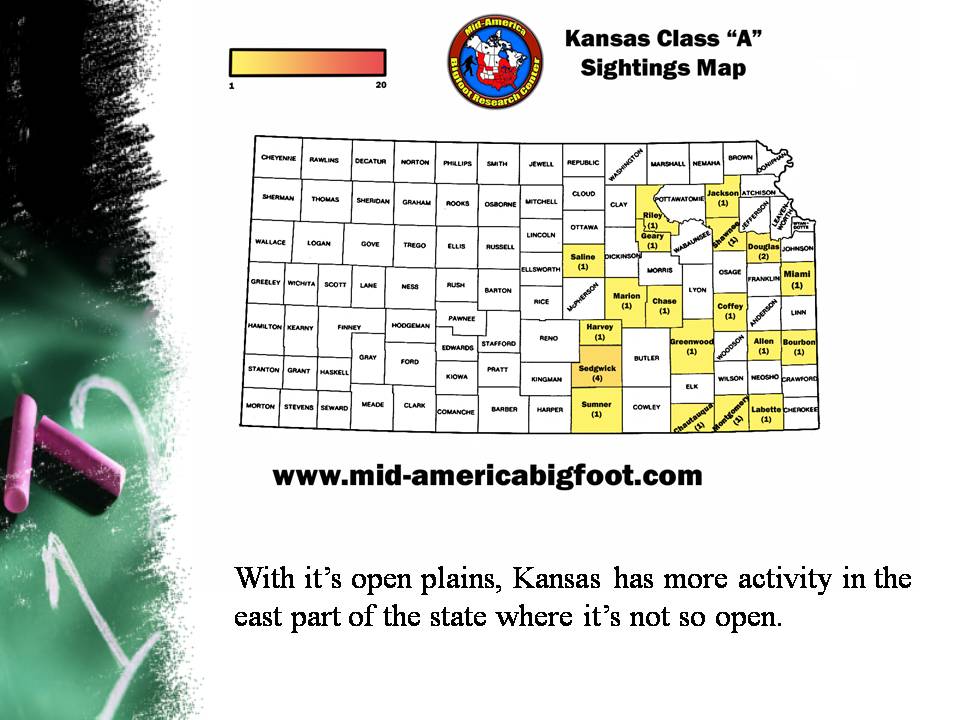
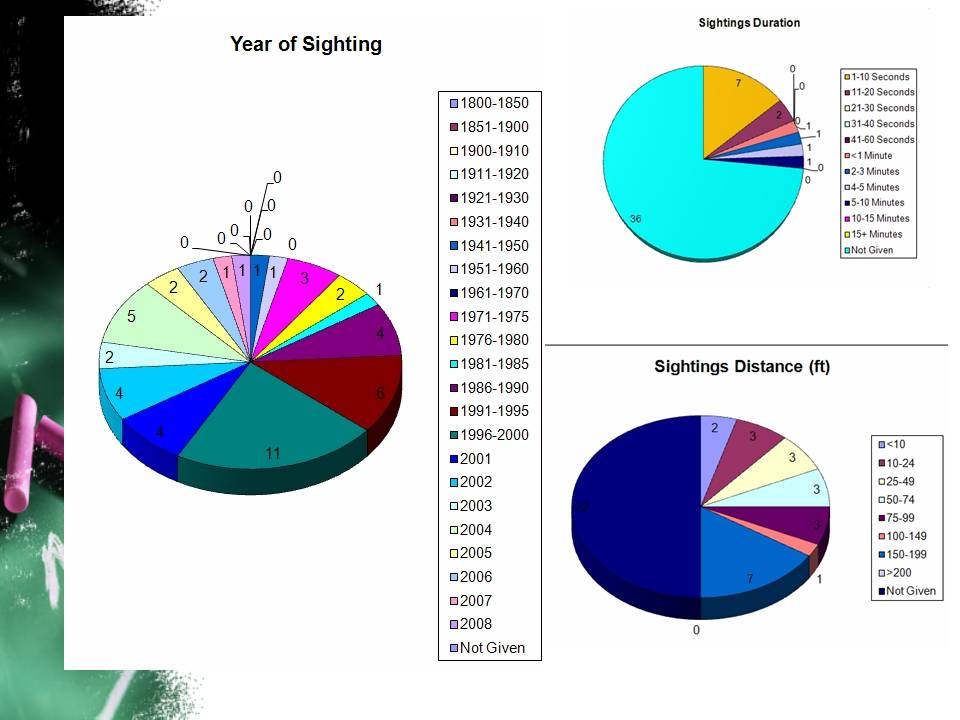
One little known feature that the MABRC has maintained for quite a few years is their National Sightings Database, in which they have taken sighting reports from all the sources that they can locate, and placed them in an easy to use format, with search capability.  Some of the main locations that reports were pulled from include but not limited to:

(BFRO) Bigfoot Field Researchers Organization
(GCBRO) Gulf Coast Bigfoot Research Organization
(TBRC) Texas Bigfoot Research Conservancy
(NAWAC) North American Woodape Conservancy
(OBF) Oregon Bigfoot 
(IBS) International Bigfoot Society
(BFE) Bigfoot Encounters


Books like the Bigfoot Casebook are also searched for sighting reports and placed on the forums in the database.  And the late John Green's sighting reports database is being added too.  The MABRC also has a presentation that explains the need for folks to turn in sighting reports, and they were generous enough to give us permission to post it here.


Saturday, August 6, 2016

Something in the woods


This movie has really hit the Bigfoot Community by storm, it isn't your typical Bigfoot horror movie, it portrays as close to factual behavior from Bigfoot as can be put on the screen.  It has the official Bigfoot Field Guide Seal of Approval.  Go to their website to find out how to purchase or watch a copy.


Friday, August 5, 2016

THE DIARY OF ELKANAH WALKER

THE DIARY OF ELKANAH WALKER

If we are to believe the Diary of Elkanah Walker, pioneer American missionary in Washington State to the Spokane Indians, he wrote:
"Bear with me if I trouble you with a little of their superstitions. They believe in a race of giants, which inhabit a certain mountain off to the west of us. This mountain is covered with perpetual snow. They (the creatures) inhabit the snow peaks. They hunt and do all their work at night. They are men stealers.
They come to the people's lodges at night when the people are asleep and take them and put them under their skins and to their place of abode without even waking. Their track is a foot and a half long. They steal salmon from Indian nets and eat then raw as the bears do. If the people are awake, they always know when they are coming very near by their strong smell that is most intolerable. It is not uncommon for them to come in the night and give three whistles and then the stones will begin to hit their houses." (Drury 1976, pp. 122-123)

Reverend Walker's established mission was approximately located twenty-five miles northwest of present day Spokane, WA. His diary entry of the snow peak to the west could be one of several peaks in the Cascade Range such as Mt. Baker, Mt. Rainier, Mt Adams or Mount St. Helens or possibly he could have meant Mt. Hood on the Oregon side of the Columbia River. But Sasquatch researchers, myself among them, generally believe the missionary was referring to Mt. St. Helens which has always carried legends of Sasquatches, ape-like men and of course the 1924 story of Fred Beck in Ape Canyon.
Missionary Walker also penned pre-civil war references to this beautiful Mt. St. Helens as a place where the white man and the Indians never frequented "and who assert it is inhabited by a race of beings of a different species, who are cannibals and whom they hold in great dread."

In his private writings, he declared the Indians called these different beings "Seatcoes or Selahticks." Words, which he thought at the time of his writings possibly referred to renegade or outcast Indians banished from tribal villages and not the elusive timber giant. Of this referential point we can't be sure, but his diaries were the first to make mention of it.

THE STORY OF MUCHALAT HARRY

THE STORY OF MUCHALAT HARRY

by Peter Byrne

According to the Indians, there was once a large number of Bigfoot living on Vancouver Island, a large island, 12,408 square miles in area, off the west coast of British Columbia. The Indians knew about them, feared them, and respected them, but granted that they were harmless. One of the Indians of the Nootka Tribe, who lived at Nootka in 1928, claims to have been carried off by them and held captive for some time.
The story, told to me by Father Anthony Terhaar of Mt. Angel Abbey in Oregon, is a curious one. Father Anthony, a much-loved missionary priest who traveled the west coast of Vancouver Island for many years, was living at Nootka at the time of the story and he knew Muchalat Harry very well. Muchalat Harry was a trapper and something of a rarity among his fellow tribesmen. He was, according to Father Anthony, a tough, fearless man, of excellent physique.

In the course of his trapping; he was wont to spend long weeks in the forest alone, something that the average Indian did not do in those days, The Indians of the coast were apparently a rather timid people and they seemed to regard the deep forest as the home and territory of the Bigfoot. When they went into the deep inland forest for any reason, they never went alone. Muchalat Harry was different from other Indians. He went in the forest alone and feared nothing.

Late one autumn Muchalat Harry set off for the woods, with his traps and camping gear. His plan was to set out a trap line and stay in the woods for several months. He headed for his favorite hunting area, the Conuma River, at the head of Tlupana Inlet. From Nootka he paddled his own canoe to the mouth of the Conuma. There he cached the canoe and headed upstream on foot. Approximately twelve miles upstream he made his base camp and, after building himself a lean-to, started to put out his trap line.

One night, while wrapped in his blankets and clad only in his underwear, he was suddenly picked up by a huge male Bigfoot and carried off into the hills. He was not carried very far, probably a distance of about two or three miles, at the most. When daylight came he was able to see that he was in a sort of camp, under a high rock shelf and surrounded by some twenty Bigfoot They were of all sexes and sizes. For some time, they stood around him and stared at him. The males to the front of the curious group females behind them and young ones to the rear. Muchalat Harry was frightened at first and his fear grew to terror when he noticed, he said, the large number of bones lying around the campsite. When he saw these he was convinced that the Bigfeet were going to eat him.

The Bigfeet did not harm him in any way. Occasionally one came forward and touched him, as if feeling him, and when they discovered that his "skin" was loose — it was in fact his woolen underwear — several came forward and pulled at it gently.

While they looked at him and examined him, Muchalat Harry sat with his back to the rock wall and did not move. He was cold and hungry, but his thoughts were only on escape. Some time in the late afternoon, curiosity on the part of the Bigfeet seemed to slacken and with most of the Bigfeet out of camp, probably food-gathering he thought, there came the opportunity that he needed. He leapt to his feet and ran for his life, never looking back. He ran downhill, toward where he guessed the river to be and sure enough, he soon came to his campsite. In what must have been blind panic he bypassed his camp and ran for twelve miles to where his canoe was cached at the mouth of the Conuma.

Father Anthony describes the story of Muchalat Harry’s arrival at Nootka as follows. It was probably three in the morning. He and his brother Benedictines were asleep and the village was quiet. Suddenly there was a series of wild cries from the waters of the inlet. Lights were lit and he and others hurried down to the water's edge. There, near-frozen and exhausted in his canoe, lay Muchalat Harry. He was barefoot and clad only in his wet and torn underwear and he had paddled his canoe through the winter night 45 miles from the mouth of the Conuma River.

Father Anthony and his companions carried the almost lifeless form up from the water's edge. It took three weeks to nurse Muchalat Harry back to sanity and good health. Father Anthony, who took him into his own care, did the nursing and he told me [Peter Byrne] that during the course of these three weeks, Muchalat Harry's hair turned to pure white.

The story of the kidnapping came out slowly. At first Muchalat Harry would talk to no one. Then he told Father Anthony what had happened and, later, others. When he was fully recovered to health he was asked when he planned to go back to collect his belongings, the camp equipment, his pots and pans, his trap line and above all, his rifle, at the lean-to on the Conuma. In 1928 a trap line and all of its pieces must have been worth a great deal to an island Indian. A rifle alone would be regarded as a highly prized possession. But Muchalat Harry never went back to the Conuma. Not only did he never return there; according to Father Anthony, he never left the settlement at Nootka, never went in the woods again for the rest of his life. He preferred to lose all of his valuables and probably hard-won possessions rather than risk another encounter with the Bigfeet.

Late in 1972 I had occasion to visit Vancouver Island. I was on a routine investigating trip and when I found myself at Nainimo, not too far by road from the west coast and the scene of Muchalat Harry's adventure, I drove there. I stopped in Gold River and obtained from the Royal Canadian Mounted Police some maps and instructions on how to get to the Conuma River area. Nowadays there is a logging road that runs all the way down to the mouth of the river, and one Sunday morning, with the logging trucks out of the way, I drove there and made camp on the Conuma. I spent several days there, walking the riverbed and exploring. I tried to make a rough determination of where Muchalat Harry might have had his lean-to and I found a place that offered a good campsite, twelve miles from the mouth of the river on the edge of a series of high bluffs. The salmon were running in the Conuma while I was there and all night long I could hear them splashing up the shallow waters of the river. In the morning black bear worked the river, getting the salmon that had come ashore in the night or had become tangled in the limbs of fallen trees that lay in the river. I counted six bears in several days.

The country was generally wild and deserted and the actual mouth of the Conuma, where it flowed into the salt waters of the inlet, was one of the most beautiful places I have ever seen. Some of the forest close to the river had been logged off, but the logging work had moved on west and while I was there it was quiet.

The days began with morning mists on the river and then warmed to the clear crispness of perfect autumn weather. Evenings were cool and damp and nights bright with starlight that provided almost enough light to read. I found no sign of Bigfoot on the Conuma, nor any sign of Muchalat Harry's trap line or lean-to. I hardly expected to find anything of the latter, after forty-odd years. But even though Muchalat Harry was long gone, the river and the forest remained unchanged, The splashing salmon, the cold, clear water of the Conuma, the moss-covered banks, the shallow pools in the forest that the Conuma drained, that were the breeding places of the salmon, the river birds, the plodding bears, the deep silent waters of the inlet, all were as they must have been forty years before, when Muchalat Harry cached his canoe and made his camp there.

© Peter Byrne, The Search for Bigfoot, 1975. 

William Roe's Sworn Affidavit

William Roe's Sworn Affidavit

William Roe claimed to have encountered a sasquatch in 1955, and was so certain about what he had seen, he made a sworn affidavit:

I, W. Roe of the City of Edmonton, in the province of Alberta make oath and say, (1) That the exhibit A attached to this, my affidavit, is absolutely true and correct in all details.
Sworn before me in the City of Edmonton, Province of Alberta, this 26th day of August, A.D. 1957.
(Signed) William Roe (Signed) by W.H. Clark Assistant Claims Agent Number D.D. 2822
EXHIBIT A. Ever since I was a small boy back in the forest of Michigan, I have studied the lives and habits of wild animals. Later, when I supported my family in Northern Alberta by hunting and trapping, I spent many hours just observing the wild things. They fascinated me. But the most incredible experience I ever had with a wild creature occurred near a little town called Tete Jaune Cache, British Columbia, about eighty miles west of Jasper, Alberta.
I had been working on the highway near Tete Jaune Cache for about two years. In October, 1955, I decided to climb five miles up Mica Mountain to an old deserted mine, just for something to do. I came in sight of the mine about three o'clock in the afternoon after an easy climb. I had just come out of a patch of low brush into a clearing when I saw what I thought was a grizzly bear, in the bush on the other side. I had shot a grizzly near that spot the year before. This one was only about 75 yards away, but I didn't want to shoot it, for I had no way of getting it out. So I sat down on a small rock and watched, my rifle in my hands.
I could see part of the animal's head and the top of one shoulder. A moment later it raised up and stepped out into the opening. Then I saw it was not a bear.
This, to the best of my recollection, is what the creature looked like and how it acted as it came across the clearing directly toward me. My first impression was of a huge man, about six feet tall, almost three feet wide, and probably weighing somewhere near three hundred pounds. It was covered from head to foot with dark brown silver-tipped hair. But as it came closer I saw by its breasts that it was female.


A drawing of the Sasquatch The Mica Mountain Sasquatch, drawn under Roe's direction by his daughter

And yet, its torso was not curved like a female's. Its broad frame was straight from shoulder to hip. Its arms were much thicker than a man's arms, and longer, reaching almost to its knees. Its feet were broader proportionately than a man's, about five inches wide at the front and tapering to much thinner heels. When it walked it placed the heel of its foot down first, and I could see the grey-brown skin or hide on the soles of its feet.
It came to the edge of the bush I was hiding in, within twenty feet of me, and squatted down on its haunches. Reaching out its hands it pulled the branches of bushes toward it and stripped the leaves with its teeth. Its lips curled flexibly around the leaves as it ate. I was close enough to see that its teeth were white and even.
The shape of this creature's head somewhat resembled a Negro's. The head was higher at the back than at the front. The nose was broad and flat. The lips and chin protruded farther than its nose. But the hair that covered it, leaving bare only the parts of its face around the mouth, nose and ears, made it resemble an animal as much as a human. None of this hair, even on the back of its head, was longer than an inch, and that on its face was much shorter. Its ears were shaped like a human's ears. But its eyes were small and black like a bear's. And its neck also was unhuman. Thicker and shorter than any man's I had ever seen.
As I watched this creature, I wondered if some movie company was making a film at this place and that what I saw was an actor, made up to look partly human and partly animal. But as I observed it more, I decided it would be impossible to fake such a specimen. Anyway, I learned later there was no such company near that area. Nor, in fact, did anyone live up Mica Mountain, according to the people who lived in Tete Jaune Cache.
Finally the wild thing must have got my scent, for it looked directly at me through an opening in the brush. A look of amazement crossed its face. It looked so comical at the moment I had to grin. Still in a crouched position, it backed up three or four short steps, then straightened up to its full height and started to walk rapidly back the way it had come. For a moment it watched me over its shoulder as it went, not exactly afraid, but as though it wanted no contact with anything strange.
The thought came to me that if I shot it, I would possibly have a specimen of great interest to scientists the world over. I had heard stories of the Sasquatch, the giant hairy Indians that live in the legends of British Columbia Indians, and also many claim, are still in fact alive today. Maybe this was a Sasquatch, I told myself.
I levelled my rifle. The creature was still walking rapidly away, again turning its head to look in my direction. I lowered the rifle. Although I have called the creature "it", I felt now that it was a human being and I knew I would never forgive myself if I killed it.
Just as it came to the other patch of brush it threw its head back and made a peculiar noise that seemed to be half laugh and half language, and which I can only describe as a kind of a whinny. Then it walked from the small brush into a stand of lodgepole pine.
I stepped out into the opening and looked across a small ridge just beyond the pine to see if I could see it again. It came out on the ridge a couple of hundred yards away from me, tipped its head back again, and again emitted the only sound I had heard it make, but what this half- laugh, half-language was meant to convey, I do not know. It disappeared then, and I never saw it again.
I wanted to find out if it lived on vegetation entirely or ate meat as well, so I went down and looked for signs. I found it in five different places, and although I examined it thoroughly, could find no hair or shells of bugs or insects. So I believe it was strictly a vegetarian.
I found one place where it had slept for a couple of nights under a tree. Now, the nights were cool up the mountain, at this time of year especially, and yet it had not used a fire. I found no sign that it possessed even the simplest of tools. Nor a single companion while in this place.
Whether this was a Sasquatch I do not know. It will always remain a mystery to me, unless another one is found.
I hereby declare the above statement to be in every part true, to the best of my powers of observation and recollection.

(Signed) William Roe 

Ruby Creek Incident

Ruby Creek Incident

by Ivan T. Sanderson
Mr. Ostman's story was related to Queen Elizabeth II when she visited British Columbia in 1959. The story is said to have been submitted to Her Majesty by an official, along with other Sasquatchery, in a remote vacation cabin at a lake near Kamloops on August 28. By coincidence, I was on that same day closeted in a small railroad shack with a charming Amerindian couple named Mr. and Mrs. George Chapman, at Jacko's old retreat of Yale, some miles lower down the Fraser River. I also was hearing a story, but firsthand, and in what turned out later to have been rather extraordinary circumstances.

We had crossed the log-filled Fraser in a small boat, rowing first away upstream, then very rapidly a long way downstream broadside, and then finally a long way back upstream again on the other side in the lee of a tall bank. Scrambling to the top of this we struck a railroad along which an Amerindian family were straggling in from the hills. By some strange quirk of fate, this turned out to be the Chapman family for whom we were looking. They hospitably invited us in to the freight office, behind which they had a small house.

That could have been a very tense or even profitless interview for several reasons. Here we were, two palefaces with locally odd accents — Robbie Christie, though born in New Jersey, has ranched in Colorado, wears a Texan-type hat, and has a vaguely British accent; while I talk a sort of bastardized Anglo-Saxon with an American intonation and a British accent, neither of which are popular in Canada — who had met up with a reticent Amerindian couple, apparently quite by chance on a railroad track, and who now had suddenly demanded to hear the facts of a series of incidents that had happened to these good people 18 years before. Somehow, however, and perhaps due mostly to a kind of mild shock, we all got off on the right foot and within a surprisingly short space of time Mrs. Chapman was recounting those terrible hours with complete clarity, only every now and then being mildly corrected by her husband, or having her account augmented by details which she had not witnessed.

We had heard their story from several sources and had read it in several printed versions, but I wanted to get it firsthand and I wanted to be able to shoot my particular glossary of awkward biological questions at principals, who were alleged eyewitnesses of a living Sasquatch in daylight. It is just as well that we crossed the Fraser River just when we did, and so met the Chapmans, because about a month afterward they were drowned crossing at the same spot late one night. The irony and tragedy of this event upset me greatly for, as I have said, I have a great liking and respect for the Amerindian peoples and I not only found this couple graciously natural and friendly but they also impressed me, as very few other people have ever done, with their sincerity and honesty. The Chapman family at the time of the incident consisted of George and Jeannie Chapman and three children. Mr. Chapman worked on the railroad. They lived near a small place called Ruby Creek, 30 miles up the Fraser River from Agassiz. It was about 3 in the afternoon of a cloudless summer day when Jeannie Chapman's eldest son, then aged 9, came running to the house saying that there was a cow coming down out of the woods at the foot of the nearby mountain. The other kids, a boy aged 7 and a little girl of 5, were still playing in a field behind the house bordering on the rail track.

Mrs. Chapman went out to look, since the boy seemed oddly disturbed, and then saw what she at first thought was a very big bear moving about among the bushes bordering the field beyond the railroad tracks. She called the two smaller children who came running immediately. Then the creature moved out onto the tracks and she saw to her horror that it was a gigantic man covered with hair, not fur. The hair seemed to be about 4 inches long all over, and of a pale yellow-brown color. To pin down this color Mrs. Chapman pointed out to me a sheet of lightly varnished plywood in the room where we were sitting. This was of a brownish-ocher color.

This creature advanced directly toward the house and Mrs. Chapman had, as she put it, "much too much time to look at it" because she stood her ground outside while the eldest boy — on her instructions — got a blanket from the house and rounded up the other children. The kids were in a near panic, she told us, and it took 2 or 3 minutes to get the blanket, during which time the creature had reached the near corner of the field only about 100 feet away from her. Mrs. Chapman then spread the blanket and, holding it aloft so that the children could not see the creature or it them, she backed off at the double to the old field and down on to the river beach, out of sight, and ran with the kids downstream to the village.

I asked her a leading question about the blanket. Had her purpose in using it been to prevent the children seeing the creature, in accord with an alleged Amerindian belief that to do so brings bad luck and often death? Her reply was both prompt and surprising. She said that, although she had heard white men tell of that belief, she had not heard it from her parents or any other of her people, whose advice regarding the so-called Sasquatch had been simply not to go farther than certain points up certain valleys, to run if she saw one, but not to struggle if one caught her, as it might squeeze her to death by mistake.

"No," she said, "I used the blanket because I thought it was after one of the kids and so might go into the house to look for them instead of following me." This seems to have been sound logic as the creature did go into the house and also rummaged through an outhouse pretty thoroughly, hauling from it a 55-gallon barrel of salt fish, breaking this open, and scattering its contents about outside. (The tragic irony of it is that all those original three children did die within 3 years, while, as I have said, a month after we interviewed them, the Chapmans and their new children drowned as well.)

Mrs. Chapman told me that the creature was about 7 feet tall. She could easily estimate the height by the various fence and line posts standing about the field. It had a rather small head and a very short, thick neck; in fact really no neck at all, a point emphasized by William Roe and by almost all others who claim to have seen one of these creatures. Its body was entirely human in shape except that it was immensely thick through its chest and its arms were exceptionally long. She did not see the feet which were in the grass. Its shoulders were very wide and it had no breasts, from which Mrs. Chapman assumed it was a male, though she also did not see any male genitalia due to the long hair covering its groin. She was most definite on one point: the naked parts of its face and its hands were much darker than its hair, and appeared to be almost black.

George Chapman returned home from his work on the railroad that day shortly before 6 in the evening and by a route that bypassed the village, so that he saw no one to tell him what had happened. When he reached his house he immediately saw the woodshed door battered in, and spotted enormous humanoid footprints all over the place. Greatly alarmed — for, like all of his people, he had heard since childhood about the "big wild men of the mountains," though he did not hear the word Sasquatch till after this incident — he called for his family and then dashed through the house. Then he spotted the foot-tracks of his wife and kids going off toward the river. He followed these until he picked them up on the sand beside the river and saw them going off downstream without any giant ones following.

Somewhat relieved, he was retracing his steps when he stumbled across the giant's foot-tracks on the river bank farther upstream. These came down out of the potato patch, which lay between the house and the river, milled about by the river, and then went back through the old field toward the foot of the mountains where they disappeared in the heavy growth.

Returning to the house, relieved to know that the tracks of all four of his family had gone off downstream to the village, George Chapman went to examine the woodshed. In our interview, after 18 years, he still expressed voluble astonishment that any living thing, even a 7-foot-6-inch man with a barrel-chest could lift a 55-gallon tub of fish out of the narrow door of the shack and break it open without using a tool. He confirmed the creature's height after finding a number of long brown hairs stuck in the slabwood lintel of the doorway, above the level of his head. George Chapman then went off to the village to look for his family, and found them in a state of calm collapse. He gathered them up and invited his father-in-law and two others to return with him, for protection of his family when he was away at work. The foot-tracks returned every night for a week and on two occasions the dogs that the Chapmans had taken with them set up the most awful racket at exactly 2 o'clock in the morning. The Sasquatch did not, however, molest them or, apparently, touch either the house or the woodshed. But the whole business was too unnerving and the family finally moved out. They never went back.

After a long chat about this and other matters, Mrs. Chapman suddenly told us something very significant just as we were leaving. She said: "It made an awful funny noise." I asked her if she could imitate this noise for me but it was her husband who did so, saying that he bad heard it at night twice during the week after the first incident. He then proceeded to utter exactly the same strange, gurgling whistle that the men in California, who had told us they had heard an Oh-Mah (or "Bigfoot") call, had given. This is a sound I cannot reproduce in print, but I can assure you that it is unlike anything I have ever heard given by man or beast anywhere in the world. To me, this information is of the greatest significance. That an Amerindian couple in British Columbia should give out with exactly the same strange sound in connection with a Sasquatch that two highly educated white men did, over 600 miles south in connection with California's Bigfoot, is incredible. If this is all a hoax or a publicity stunt, or mass hallucination, as some people have claimed, how does it happen that this noise — which defies description — always sounds the same no matter who has tried to reproduce it for me?

From: Abominable Snowmen: Legend Come To Life by Ivan T. Sanderson.

Bluff Creek History

Bluff Creek History

by Ivan T. Sanderson
In August of 1958 — on the morning of the 27th to be precise — a very sane and sober citizen by the name of Mr. Jerald Crew, of Salyer township, Humboldt County, northwest California, an active member of the Baptist Church, a teetotaler and a man with a reputation in his community that can only be described as heroic in face of certain almost unique personal tragedy, went to his work with heavy-duty equipment at the head of this new lumber access road being pushed into uninhabited and only roughly surveyed territory near the borders of Humboldt and Del Norte Counties. This huge block of territory is crossed kitty-corner from the south at Willow Creek to the northeast by a winding blacktop road, and from east to west by only four other roads of lower grade. Logging trails and some "jeep-roads" now finger into it from these roads and from the main arteries that enclose it to north, west, south, and east, but these are of very limited extent and are hardly used at all. Jerry Crew's crawler-tractor had been left overnight at the head of the new road about 20 miles north of its digression from the narrow blacktop that runs north through the Hoopa (as it is on maps) Amerindian Reservation from Willow Creek to a place with the delightful name of Happy Camp up near the Oregon border.

Jerry was an older member of a crew bulldozing this new road into virtually unexplored territory for one Mr. Ray Wallace, subcontractor to Messrs. Block and Company who had, in turn, contracted with the National Parks Service to carry out the work. He is a local man. His fellow workers were for the most part also local men and included a nephew, James Crew, a very level-headed young chap, others whom I shall mention by name in a minute, and two experienced loggers of Huppa Indian origin. The crew had considerable heavy equipment at the scene of operations and had started work in late May as soon as what little snow there is in this area had melted and the much more deadly mud had firmed up. The road had been under construction for two seasons already. The country is mountainous; though this is the understatement of the year, being to most intents and everywhere almost vertical so that you can only go up on all fours or down on your bottom. Unless you make an exaggerated and exhausting climb you cannot see more than about four square miles of the country because you are always on the side of something going either straight up or almost straight down and unless a tree has fallen or been cut out, you can't see anything because bare rock is confined to the uppermost summits of the peaks and ridges. The road crawls laboriously up the face of the western wall that encloses a stream known as Bluff Creek. It is still unsurfaced and when I visited it in 1959 was ankle-deep in ultra-fine dust that surpasses anything the deserts of Arizona can produce at their damnedest. All along this mountainous trail there are the stumps of vast trees cut and hauled out, and great slides of friable shales, gray, brown, blue, or even green that have been sliced out of the sheer valley side. The great dozers and crawlers clank and roar in the hot summer sunlight as they gnaw their relentless way into this timeless land. The great trees seem to recoil a little from their mechanical jangling and screeching, but day by day these bright yellow and red monsters munch away ever deeper into one of the last of America's real wildernesses.

Those employed on this work lived during the work-week in camp near this road- head. They had trailers or tents or prefabricated houses and some of them had their families with them and stayed there all week. Others with families’ resident in nearby communities normally went home on Friday night and returned on the following Monday morning. The younger fellows usually did likewise, for the drive to Willow Creek took only about 2 hours for those who knew the road. Jerry Crew's practice was to return to his family over the week end, leaving his machine parked at the scene of current operations. He had been on this job for 3 months that year before the eventful morning which blew up the storm that literally rocked Humboldt County, California and made the pages of the world press but which then sort of folded in upon itself and was heard of no more for a year.

What Jerry Crew discovered when he went to start up his "cat" was that somebody had inspected it rather thoroughly during the previous night, as could be plainly seen by a series of footprints that formed a track to, all around, and then away from the machine. Such tracks would not have aroused his curiosity under normal circumstances because there were three dozen men at that road-head and the newly scraped roadbed was covered with soft mud areas alternating with patches of loose shale. What did startle him was that these footprints were of a shoeless or naked foot of distinctly human shape and proportions but by actual measurement just 17 inches long!

Of these, Jerry Crew took an extremely dim view. He had heard tell of similar tracks having been seen by another road gang working 8 miles north of a place called Korbel on the Mad River earlier that year and his nephew, Jim Crew, had also mentioned having come across something similar in this area. Being a pragmatic family man he felt, he told me, some considerable annoyance that some "outsider" should try to pull such a silly stunt on him. He at first stressed an outsider because, although his fellow workers liked a harmless joke as much as any man, he knew they were far too tired to go clomping around in the dark after the sort of working day they put in on that job, making silly footprints around the equipment. Then, he tells me, he got to thinking about this outsider and wondered just how he had got there without passing the camps farther down the road and being spotted, and how he had gotten out again, or where he had gone over these precipitous mountains clothed in tangled undergrowth. He followed the tracks up. And that is where he got his second shock.

Going backward he found that they came almost strain down an incline of about 75 degrees on to the road ahead the parked "cat", then proceeded down the road on one side, circled the machine, and then went on down the road toward the camp. Before getting there, however, they cut across the road and went straight down an even steeper incline and continued into the forest with measured stride varying only when an obstacle had to be stepped over or the bank was so steep purchase could be obtained by digging in the heels. The stride was enormous and proved on measurement to be from 46 to 60 inches and to average about 50 inches or almost twice that of his own. Jerald Crew was not only mystified; he was considerably peeved. He went to fetch some of his colleagues. Then he received his third shock that morning.

The majority of them, stout fellows and good friends that they were, refused to even go and look at this preposterous phenomenon that he told them he had found and he had a hard time persuading any of them that even the tracks were there. Eventually, some of the men, who had in any case to go that way to their work, agreed to go along with him and take a look. Then they got their shocks and, Jerry told me, some of them "looked at me real queer." But there were others who reacted differently, and it then transpired that all of them had either seen something similar thereabouts or elsewhere, or had heard of them from friends and acquaintances whom they regarded as totally reliable. The only Amerinds present said nothing at that time. Then they all went back to work.

Nothing further happened for almost a month, then once again these monstrous Bigfoot appeared again overnight around the equipment and farther down the road toward the valley, notably around a spring. About that time, Mr. Ray Wallace, the contractor, returned from a business trip. He had heard rumors on his way in that either his men were pulling some kind of stunt up in the hills or that some "outsider" was pulling one on them. He paid little attention to these reports but he was, he told me, somewhat apprehensive because the job was a tough one, skilled and reliable workers were not plentiful, and the location was not conducive to the staying power of anyone. When he reached the camp and heard the details of the Bigfoot he was more than just skeptical. He was downright angry. Moreover, all he encountered was more talk which he at that time suspected was some sort of prank but just possibly one prompted by more than mere high spirits or boredom.

The matter was until then and for a further 3 weeks a purely local affair known only to the men working on the road, and their immediate families for they did not care to speak about it too casual acquaintances or even friends. Then, in the middle of September a Mrs. Jess Bemis, wife of one of the men working on the road and one of the skeptics among the crew, wrote a letter to the leading local newspaper, the Humboldt Times of Eureka, which said in part "A rumor started among the men, at once, of the existence of a Wild Man. We regarded it as a joke. It was only yesterday that my husband became convinced that the existence of such a person (?) is a fact. Have you heard of this wild man?" Mr. Andrew Genzoli of that paper told me that he regarded this letter with a thoroughly jaundiced eye but that the longer he saw it about his desk the brighter grew the clear blue light of his built-in news-sense, until he could restrain himself no longer and ran the letter in a daily column that he writes.

There was little response where he had expected a near storm of derision; instead a trickle of tentatively confirmatory correspondence began to come in from the Willow Creek area. This was continuing sub rosa when, on October 2, the maker of the tracks appeared again on his apparently rather regular round leaving tracks for 3 nights in succession and then vanishing again for about 5 days. This time Jerry Crew had prepared for his advent with a supply of plaster of Paris and made a series of casts of both right and left feet early one morning. Two days later he took a couple of days off to drive to Eureka on personal business and carried the casts along with him to show to a friend. While there somebody mentioned to Andrew Genzoli that a man was in town who had made casts of the prints and he was persuaded to go and fetch Jerry. Andrew Genzoli is an old news hand but of the new school; he can sense a good story as fast as any man but he is properly averse to too good a story. When he met Jerry Crew and saw his trophies he realized he had some real live news, not just a "story," on his hands, and he ran a front-pager on it with photographs the next day. Then the balloon went up.

The wire services picked it up and almost every paper in the country printed it while cables of inquiry flooded in from abroad. The first I heard of it was a cable from a friend in London: he seemed to be slightly hysterical. I get a lot of esoteric cables during the year about sea monsters, two-headed calves, reincarnated Indian girls, and so forth, the majority of which I am constrained to do something about because the world is, after all, a large place and we don't know much about a lot of it as yet, but this one I frankly refused to accept mostly because I rather naturally assumed that the location as given (California) must be a complete error or a misquote. I wracked my brains for any place name in Eurasia or Africa that might have nine letters, begin with "K" and end in "ia." The best we could come up with was Corinthia but this was even more unlikely. Then somebody suggested Carpathia, the country of Dracula and other humanoid unpleasantness’s, and we actually spent 6 dollars on a follow-up. There are few people interested enough in such abstruse matters as to spend that sum in pursuit of truth but I fancy there were many on the morning of October 6, 1958 who doubted what they read in their morning papers just as fervently as I did this cable.

The point I want to make is that this whole bit did sound quite absurd even to us, who became immune to such shocks years ago. It is all very well for abominable creatures to be pounding over snow-covered passes in Nepal and Tibet; after all giant pandas and yaks, and an antelope with a nose like Jimmy Durante, and other unlikely things come from thereabouts; and it is even conceivable that there might be little hairy men in the vast forests of Mozambique in view of the almost equally unlikely more or less hairless pigmies of the eastern Congo which are there for all tourists to see, but a wild man with a 17-inch foot and a 50-inch stride tromping around California was then a little too much to ask even us to stomach, especially as we had not yet got the news-stories. The amazing thing in this case was that the world press took it seriously enough even to carry it as a news item.

Not so the rest of humanity. One and all, apart from a few ardent mystics and professional crackpots, and including even the citizens of Humboldt County itself rose up in one concerted howl of righteous indignation. Everybody connected with the business, and notably poor Mr. Genzoli, was immediately almost smothered in brickbats. In the meantime however, a number of other things had happened. Most notable among these was the reappearance of "Bigfoot" as he was called one night before Ray Wallace returned to his operations. Now it so happened that a brother of the contractor, Wilbur Wallace, was working on this job and he, besides seeing the foot-tracks many times, witnessed three other annoying and to him most startling occurrences, which he had reported to his brother. I will repeat these roughly in his own words which appeared to me not only straightforward but most convincing.

First, it was reported to him by one of his men that a nearly full 55-gallon drum of diesel fuel which had been left standing beside the road was missing and that Bigfoot tracks led do the road from a steep bank to this spot where it had stood, then crossed the road, continued on down the hill and finally went over the lower bank and away into the bush. Will Wallace went to inspect and found the tracks exactly as the men had stated. He also found the oil drum at the bottom of steep bank about 175 feet from the road. It had rolled down this bank and had apparently been thrown from the top. What is more, it had been lifted from its original resting place and apparently carried to this point, for there were no marks in the soft mud of its having been either rolled or dragged all that distance. Second, a length of 18-inch galvanized steel culvert disappeared from a dump overnight and was found at the bottom of another bank some distance away. Third, he reported a wheel with tire for a "carry-all" earth-mover, weighing over 700 pounds, had likewise been in part lifted and in part rolled a quarter of a mile down the road and hurled into a deep ravine. Ray Wallace, however, still remained skeptical even after hearing this from his own brother. However, on his first morning at the location he stopped for a drink at a spring on the way down the hill and stepped right into a mass of the big prints in the soft mud around the outflow. Then, I gather from him, though he is a man with a wonderfully good humor, he got "good and mad." There was for him no longer any question about the existence of these monstrous human-like tracks but there remained the question as to who was perpetrating them, and why. Ray Wallace is a hard-boiled and pragmatic man and he was already experiencing trouble keeping men on the job. Handpicked as they were not a few had just had to leave for one apparently good reason or another. Only later did he learn that almost all of them did so not because they were scared by the Bigfoot, but either because their wives were or because of the ribbing they had to take when they went back to civilization, even for the evening to nearby Willow Creek.

Ray Wallace said he at first thought somebody was deliberately trying to wreck his contract and he was not alone. However, the local representative of the Humboldt Times, Mrs. Elizabeth (Betty) Allen, set about to investigate the possibility on her own, and discovered beyond a doubt that neither good nor bad publicity, nor any kind of "scare" actually made any difference to Mr. Wallace's contract. First he was a subcontractor; second he was more than up to schedule; third there was no time set on the job; and fourth, it was basically contracted by Messrs. Block and Company with the Forest Service on a performance, not a time, basis. Ray Wallace got so angry he brought in a man named Ray Kerr, who had read of the matter in the press and asked for a job in order to be able to spend his spare time trying to track the culprit. Kerr brought with him a friend by the name of Bob Breazele, who had hunted professionally in Mexico, owned four good dogs, and a British-made gun of enormous caliber which considerably impressed the locals. Kerr, an experienced equipment operator, did a full daily job: Breazele did not take a job but hunted.

Tracks were seen and followed by them. Then one night in late October, these two were driving down the new road after dark and state that they came upon a gigantic humanoid or human-shaped creature, covered with 6-inch brown fur, squatting by the road. They said it sprang up in their headlights and crossed the road in two strides to vanish into the undergrowth. They went after it with a flashlight but the underbrush was too thick to see anything. They measured the road and found it to be exactly 20 feet wide from the place where the creature had squatted to the little ditch where it had landed after those two strides. Spurred by this encounter they redoubled their hunting forays but their dogs disappeared a few days later when they were following Bigfoot's tracks some distance from the road-head. They were never seen again though story was told — but later denied by its teller — that their skins and bones were found spattered about some trees. Though this story was denied, there is as much reason to believe that this was done to obviate ridicule as to clear a conscience.

All this was, of course, taken with hoots of derision by everybody even in Willow Creek who had not seen any tracks — but with one notable exception. This was Andrew Genzoli and he sent his newspaper's senior staff photographer to Bluff Creek. The party saw fresh tracks at night and photographed them. They also found something else; as did Ray Wallace later. (I have this first hand from these professional skeptics.) At first, the photographer told me, he was more than just skeptical but when he found the tracks and inspected them he not only was convinced that they were not a hoax or a publicity stunt but, as he put it, "I got the most awful feeling that I can't really describe, but it was nearer fright than anything I ever felt when in service." But worse was in store for the newsmen for, in following the tracks down the road, they came across a pile of feces of typically human form but, as they put it, "of absolutely monumental proportions." He then added, "I can only describe it as a 2-ton bear with chronic constipation."

They contemplated going to fetch a shovel and some container and taking this back to Eureka for analysis but it was a hot night and a 5-hour drive over a dangerous road and also, as they readily admitted, that strange laziness that so often intervenes in offbeat and rather alarming cases of this nature took over and cast the die. Press coverage had gone far enough, and they were not ecologists. Later, Ray Wallace stumbled upon a similar enormous mass of human-shaped droppings. He shoveled them into a can and found that they occupied exactly the same volume as a single evacuation of a 1200-pound horse.

Further foot-tracks and other incidents continued all that fall and throughout the winter until the spring of 1959 ending in February. However, later in the spring, two fliers, a husband and wife in a private plane, were flying over the Bluff Creek area. It was April and there was still snow on the mountain-tops some of which are bare of trees. It is alleged that they spotted great tracks in the snow and that on following them up they sighted the creature that had made them. It was enormous, humanoid, and covered with brown fur, according to secondhand accounts. I tried, and am still trying to locate this couple, with the co-operation of local fliers, several of them having heard of the report, and despite the praiseworthy clannishness of fliers and their willing offers to help, I have not at the time of writing been able to identify this couple. The story may be a rumor or wishful thinking. So also may, three other recent and a whole host of past, old, and even ancient reports of actual meetings with one or more bigfoot in this area.

Among these are alleged statements by two doctors of having met one on Route 299 earlier in 1958; and of a lady of much probity who with her daughter saw two, one smaller by far than the other, feeding on a hillside above the Hoopa Valley. This lady, to whom a partner of mine talked but who does not wish her name publicized, also stated that when she was a young girl, people used to see these creatures from time to time when they went fishing up certain creeks, and she once saw one swimming Bluff Creek when it was in flood. She also stated that in the olden days people did not go above certain points up the side valleys, due to the presence of these creatures.

More important was a positive flood of further alleged discoveries of similar foot-tracks by all manner of local citizenry over a wide area and extending back for many years that came to light as soon as the local press began to take this whole matter seriously. But as these came in, public resentment and ridicule mounted so that the reporters became ever cagier. Finally, Betty Allen, who as an old-time resident with experience as an Assistant U.S. Commissioner in Alaska, started talking to the Huppa and Yurok Amerinds about these matters and, little by little, an amazing picture emerged.

From: Abominable Snowmen: Legend Come to Life by Ivan T. Sanderson.

The Bauman Incident

The Bauman Incident

Frontiersmen are not, as a rule, apt to be very superstitious. They lead lives too hard and practical, and have too little imagination in things spiritual and supernatural. I have heard but few ghost-stories while living on the frontier, and those few were of a perfectly commonplace and conventional type.

But I once listened to a goblin-story which rather impressed me. It was told by a grizzled, weatherbeaten old mountain hunter, named Bauman, who was born and had passed all of his life on the frontier. He must have believed what he said, for he could hardly repress a shudder at certain points of the tale; but he was of German ancestry; and in childhood had doubtless been saturated with all kinds of ghost and goblin lore, so that many fearsome superstitions were latent in his mind; besides, he knew well the stories told by the Indian medicine-men in their winter camps, of the snow-walkers, and the spectres, and the formless evil beings that haunt the forest depths, and dog and waylay the lonely wanderer who after nightfall passes through the regions where they lurk; and it may be that when overcome by the horror of the fate that befell his friend, and when oppressed by the awful dread of the unknown, he grew to attribute, both at the time and still more in remembrance, weird and elf in traits to what was merely some abnormally wicked and cunning wild beast; but whether this was so or not, no man can say.

When the event occurred Bauman was still a young man, and was trapping with a partner among the mountains dividing the forks of the Salmon from the head of Wisdom River. Not having had much luck, he and his partner determined to go up into a particularly wild and lonely pass through which ran a small stream said to contain many beaver. The pass had an evil reputation because the year before a solitary hunter who had wandered into it was there slain, seemingly by a wild beast, the halfeaten remains being afterwards found by some mining prospectors who had passed his camp only the night before.

The memory of this event, however, weighed very lightly with the two trappers, who were as adventurous and hardy as others of their kind. They took their two lean mountain ponies to the foot of the pass where they left them in an open beaver meadow, the rocky timber-clad ground being from there onward impracticable for horses. They then struck out on foot through the vast, gloomy forest, and in about four hours reached a little open glade where they concluded to camp, as signs of game were plenty.

There was still an hour or two of daylight left, and after building a brush lean-to and throwing down and opening their packs, they started upstream. The country was very dense and hard to travel through, as there was much down timber, although here and there the sombre woodland was broken by small glades of mountain grass. At dusk they again reached camp. The glade in which it was pitched was not many yards wide, the tall, close-set pines and firs rising round it like a wall. On one side was a little stream, beyond which rose the steep mountain slope, covered with the unbroken growth of evergreen forest.

They were surprised to find that during their absence something, apparently a bear, had visited camp, and had rummaged about among their things, scattering the contents of their packs, and in sheer wantonness destroying their lean-to. The footprints of the beast were quite plain, but at first they paid no particular heed to them, busying themselves with rebuilding the lean-to, laying out their beds and stores and lighting the fire.

While Bauman was making ready supper, it being already dark, his companion began to examine the tracks more closely, and soon took a brand from the fire to follow them up, where the intruder had walked along a game trail after leaving the camp. When the brand flickered out, he returned and took another, repeating his inspection of the footprints very closely. Coming back to the fire, he stood by it a minute or two, peering out into the darkness, and suddenly remarked, "Bauman, that bear has been walking on two legs." Bauman laughed at this, but his partner insisted that he was right, and upon again examining the tracks with a torch, they certainly did seem to be made by but two paws or feet. However, it was too dark to make sure. After discussing whether the footprints could possibly be those of a human being, and coming to the conclusion that they could not be, the two men rolled up in their blankets, and went to sleep under the lean-to.

At midnight Bauman was awakened by some noise, and sat up in his blankets. As he did so his nostrils were struck by a strong, wild-beast odor, and he caught the loom of a great body in the darkness at the mouth of the lean-to. Grasping his rifle, he fired at the vague, threatening shadow, but must have missed, for immediately afterwards he heard the smashing of the underwood as the thing, whatever it was, rushed off into the impenetrable blackness of the forest and the night.

After this the two men slept but little, sitting up by the rekindled fire, but they heard nothing more. In the morning they started out to look at the few traps they had set the previous evening and put out new ones. By an unspoken agreement they kept together all day, and returned to camp towards evening.

On nearing it they saw, hardly to their astonishment, that the lean-to had again been torn down. The visitor of the preceding day had returned, and in wanton malice had tossed about their camp kit and bedding, and destroyed the shanty. The ground was marked up by its tracks, and on leaving the camp it had gone along the soft earth by the brook, where the footprints were as plain as if on snow, and, after a careful scrutiny of the trail, it certainly did seem as if, whatever the thing was, it had walked off on but two legs.

The men, thoroughly uneasy, gathered a great heap of dead logs and kept up a roaring fire throughout the night, one or the other sitting on guard most of the time. About midnight the thing came down through the forest opposite, across the brook, and stayed there on the hillside for nearly an hour. They could hear the branches crackle as it moved about, and several times it uttered a harsh, grating, long-drawn moan, a peculiarly sinister sound. Yet it did not venture near the fire.

In the morning the two trappers, after discussing the strange events of the last 36 hours, decided that they would shoulder their packs and leave the valley that afternoon. They were the more ready to do this because in spite of seeing a good deal of game sign they had caught very little fur. However it was necessary first to go along the line of their traps and gather them, and this they started out to do. All the morning they kept together, picking up trap after trap, each one empty. On first leaving camp they had the disagreeable sensation of being followed. In the dense spruce thickets they occasionally heard a branch snap after they had passed; and now and then there were slight rustling noises among the small pines to one side of them.

At noon they were back within a couple of miles of camp. In the high, bright sunlight their fears seemed absurd to the two armed men, accustomed as they were, through long years of lonely wandering in the wilderness, to face every kind of danger from man, brute or element. There were still three beaver traps to collect from a little pond in a wide ravine near by. Bauman volunteered to gather these and bring them in, while his companion went ahead to camp and made ready the packs.

On reaching the pond Bauman found three beavers in the traps, one of which had been pulled loose and carried into a beaver house. He took several hours in securing and preparing the beaver, and when he started homewards he marked, with some uneasiness, how low the sun was getting. As he hurried toward camp, under the tall trees, the silence and desolation of the forest weighed on him. His feet made no sound on the pine needles and the slanting sun-rays, striking through among the straight trunks, made a gray twilight in which objects at a distance glimmered indistinctly. There was nothing to break the gloomy stillness which, when there is no breeze, always broods over these sombre primeval forests.

At last he came to the edge of the little glade where the camp lay, and shouted as he approached it, but got no answer. The camp fire had gone out, though the thin blue smoke was still curling upwards.

Near it lay the packs wrapped and arranged. At first Bauman could see nobody; nor did he receive an answer to his call. Stepping forward he again shouted, and as he did so his eye fell on the body of his friend, stretched beside the trunk of a great fallen spruce. Rushing towards it the horrified trapper found that the body was still warm, but that the neck was broken, while there were four great fang marks in the throat.

The footprints of the unknown beast-creature, printed deep in the soft soil, told the whole story.

The unfortunate man, having finished his packing, had sat down on the spruce log with his face to the fire, and his back to the dense woods, to wait for his companion. While thus waiting, his monstrous assailant, which must have been lurking in the woods, waiting for a chance to catch one of the adventurers unprepared, came silently up from behind, walking with long noiseless steps and seemingly still on two legs. Evidently unheard, it reached the man, and broke his neck by wrenching his head back with its fore paws, while it buried its teeth in his throat. It had not eaten the body, but apparently had romped and gambolled around it in uncouth, ferocious glee, occasionally rolling over and over it; and had then fled back into the soundless depths of the woods.

Bauman, utterly unnerved, and believing that the creature with which he had to deal was something either half human or half devil, some great goblin-beast, abandoned everything but his rifle and struck off at speed down the pass, not halting until he reached the beaver meadows where the hobbled ponies were still grazing. Mounting, he rode onwards through the night, until beyond reach of pursuit.

From: The Wilderness Hunter (1892) by Theodore Rosevelt

The Ape Canyon Story


The Attack

First of all, I wish to give an account of the attack and tell of the famous incident of July, 1924, when the "Hairy Apes" attacked our cabin. We had been prospecting for six years in the Mt. St. Helens and Lewis River area in Southwest Washington. We had, from time to time, come across large tracks by creek beds and springs. In 1924 I and four other miners were working our gold claim, the Vander White. It was two miles east of Mt. St. Helens near a deep canyon now named "Ape Canyon" — which was so named after an account of the incident reached the newspapers.

Hank, a great hunter and good woodsman, was always a little apprehensive after seeing the tracks. The tracks were large and we knew that no known animal could have made them: the largest measured nineteen inches long.

It was in the middle of July, and we had received a good assay on our claim, and everyone was excited. I remember I had a tooth that was aching, and I suggested to Hank that he should take me to town to see a dentist; but he was so enthused in the prospects of the gold mine, he barely took time to answer me. He replied that "God or the Devil" could not get him away from there. We had all come up in his Ford, and I had no way to get to town unless he took me. So when we went back to our cabin, on the north side of the canyon, I had a nagging tooth ache and little appetite for our evening meal of beans and hotcakes.

Hank, though apprehensive, was still determined. We had been hearing noises in the evening for about a week. We heard a shrill, peculiar whistling each evening. We would hear it coming from one ridge, and then hear an answering whistling from another ridge. We also heard a sound which I could best describe as a booming, thumping sound — just like something was hitting its self on its chest.

Hank asked me to accompany him to the spring, about a hundred yards from our cabin, to get some water, and suggested we take our rifles — to be on the safe side. We walked to the spring, and then, Hank yelled and raised his rifle, and at that instant, I saw it. It was a hairy creature, and he was about a hundred yards away, on the other side of a little canyon, standing by a pine tree. It dodged behind the tree, and poked its head out from the side of the tree. And at the same time, Hank shot. I could see the bark fly out from the tree from each of his three shots. Someone may say that that was quite a distance to see the bark fly, but I saw it. The creature I judged to have been about seven feet tall with blackish-brown hair. It disappeared from our view for a short time, but then we saw it, running fast and upright, about two hundred yards down the little canyon. I shot three times before it disappeared from view.

We took the water back to the cabin, and explained the affair to the rest of the party; and we all agreed, including Hank, to go home the next morning as it would be dark before we could get to the car. We agreed it would be unsound to be caught by darkness on the way out.

Nightfall found us in our pine-log cabin. We had built the cabin ourselves, and had made it very sturdy. It stood for years afterward, and was visited by many sight seers until a few years ago when it was burned to the ground — the circumstances of the fire, I do not recall.

In the cabin, we had a long bunk bed in which two could sleep, feet to feet — the rest of us sleeping on pine boughs on the floor. At one end of the cabin, we had a fireplace, fashioned out of rocks. There were no windows in the cabin. So darkness found all of us in the cabin, more calm now (and my tooth was better, somehow the excitement seemed to work a temporary cure on it). We were sitting around, puffing on pipes, and talking about the trip home the next day.

Each of us settled down in his crude, but welcomed bed, and soon fell asleep. About midnight, we were all awakened. Hank, who was sleeping on the floor was yelling and kicking. But the noise that had awakened us was a tremendous thud against the cabin wall. Some of the chinking had been knocked loose from between the logs and had fell across Hank's chest. He had his rifle in his hand and was waving it back and forth as he kicked and yelled. (Hank always slept with his gun near by — it was a Remington automatic, my gun being a 30-30 Winchester, which I still have).

I helped to get the chinking off him, and he jumped to his feet. Then, we heard a great commotion outside: it sounded like a great number of feet trampling and rattling over a pile of our unused shakes. We grabbed our guns. Hank squinted through the space left by the chinking. By actual count, we saw only three of the creatures together at one time, but it sounded like there were many more.

This was the start of the famous attack, of which so much has been written in Washington and Oregon papers through out the years. Most accounts tell of giant boulders being hurled against the cabin, and say some even fell through the roof, but this was not quite the case. There were very few large rocks around in that area. It is true that many smaller ones were hurled at the cabin, but they did not break through the roof, but hit with a bang, and rolled off. Some did fall through the chimney of the fireplace. Some accounts state I was hit in the head by a rock and knocked unconscious. This is not true.

The only time we shot our guns that night was when the creatures were attacking our cabin. When they would quiet down for a few minutes, we would quit shooting. I told the rest of the party, that maybe if they saw we were only shooting when they attacked, they might realize we were only defending ourselves. We could have had clear shots at them through the opening left by the chinking had we chosen to shoot. We did shoot, however, when they climbed up on our roof. We shot round after round through the roof. We had to brace the hewed-logged door with a long pole taken from the bunk bed. The creatures were pushing against it and the whole door vibrated from the impact. We responded by firing many more rounds through the door. They pushed against the walls of the cabin as if trying to push the cabin over, but this was pretty much an impossibility, as previously stated the cabin was a sturdy made building. Hank and I did most of the shooting — the rest of the party crowded to the far end of the cabin, guns in their hands. One had a pistol, which still is in my family's possession, the others clutched their rifles. They seemed stunned and incredulous.

The attack continued the remainder of the night, with only short intervals between. A most profound and frightening experience occurred when one of the creatures, being close to the cabin, reached an arm through the chinking space and seized one of our axes by the handle (a much written about incident and a true one). Before the thing could pull the axe out, I swiftly turned the head of the axe upright, so that it caught on the logs; and at the same time Hank shot, barely missing my hand.

The creature let go, and I pulled the handle back in, and put the axe in a safe place.

A humorous thing I well remember was Hank singing: "If you leave us alone, we'll leave you alone, and we'll all go home in the morning." He did not mean it to be humorous, for Hank was dead serious, and sang under the impression that the "Mountain Devils" as he called them, might understand and go away.

The attack ended just before daylight. Just as soon as we were sure it was light enough to see, we came cautiously out of the cabin.

It was not long before I saw one of the apelike creatures, standing about eighty yards away near the edge of Ape Canyon. I shot three times, and it toppled over the cliff, down into the gorge, some four hundred feet below.

Then Hank said that we should get out of there as soon as possible; and not bother to pack our supplies or equipment out; "After all," he said, "it's better to lose them, than our lives." We were all only too glad to agree. We brought out only that which we could get in our packsacks. We left about two hundred dollars in supplies, powder, and drilling equipment behind.

I tried to persuade everyone not to relate the happenings to anyone, and they agreed, but Hank soon let the cat out of the bag. We made our way to Spirit Lake, and Hank went in to the ranger station. He had told the ranger earlier about the tracks, and the ranger had replied, "Let me know if you find out what they are." That was just what Hank did, to the puzzlement of the ranger.

When we were back home in Kelso, Washington, he told some of his friends, and somehow the story leaked out to the papers, and the Great Hairy Ape Hunt of 1924 was on.

Local reporters interviewed us. They came from Portland and Seattle — even a big game hunter from England came asking questions, and he had a large gun with him that must have been an elephant gun. Many people flocked to the Mt. St. Helen's area looking for the "Great Hairy Apes", or "Mountain Devils." I, myself, went back with two reporters and a detective from Portland, Oregon. We found large tracks, and they photographed them. We did not see any of the Apemen then, nor could we find the ones we had shot.

So people were asking questions: Was it true? Or was it just a wild tale? I can assure you it is true. Are they human? animal? or devils? I will answer that question in this book. That was a great "Apehunt" in 1924, and the last few years, more and more people have reported seeing them. There is an Apehunt being revived again, and another man has written a book on the subject and has formed a club whose purpose is to find evidence to prove what they already believe: that abominable snowmen of America do exist.

A wealthy person has offered a large sum of money for anyone that can capture one alive. Sightings have been reported in Canada, Washington, Oregon, and northern California. But the purpose of this book, is not only to relate my experiences, but also to bring to light my knowledge about the Abominable Snowmen. I do not wish to embark upon an expedition, but I wish to tell what these beings are.